The whole CMA course · one page
CMA Course Roadmap: from Class 12 to Cost Accountant
Every step of the ICMAI Cost and Management Accountant course in one place: the doors you can enter through, what you study at Foundation, Intermediate and Final, the 15-month practical training, how long the road takes, what ICMAI charges, and where the qualification leads. Written for students and parents in Coimbatore by Masters Professional Academy, a CMA-only institute with 18+ years of CMA teaching.
- 3 levels · 20 papers
- Exams every June and December
- 15 months practical training
- About 3 years after Class 12
- Graduates enter Intermediate directly
At a glance
The road in five stops

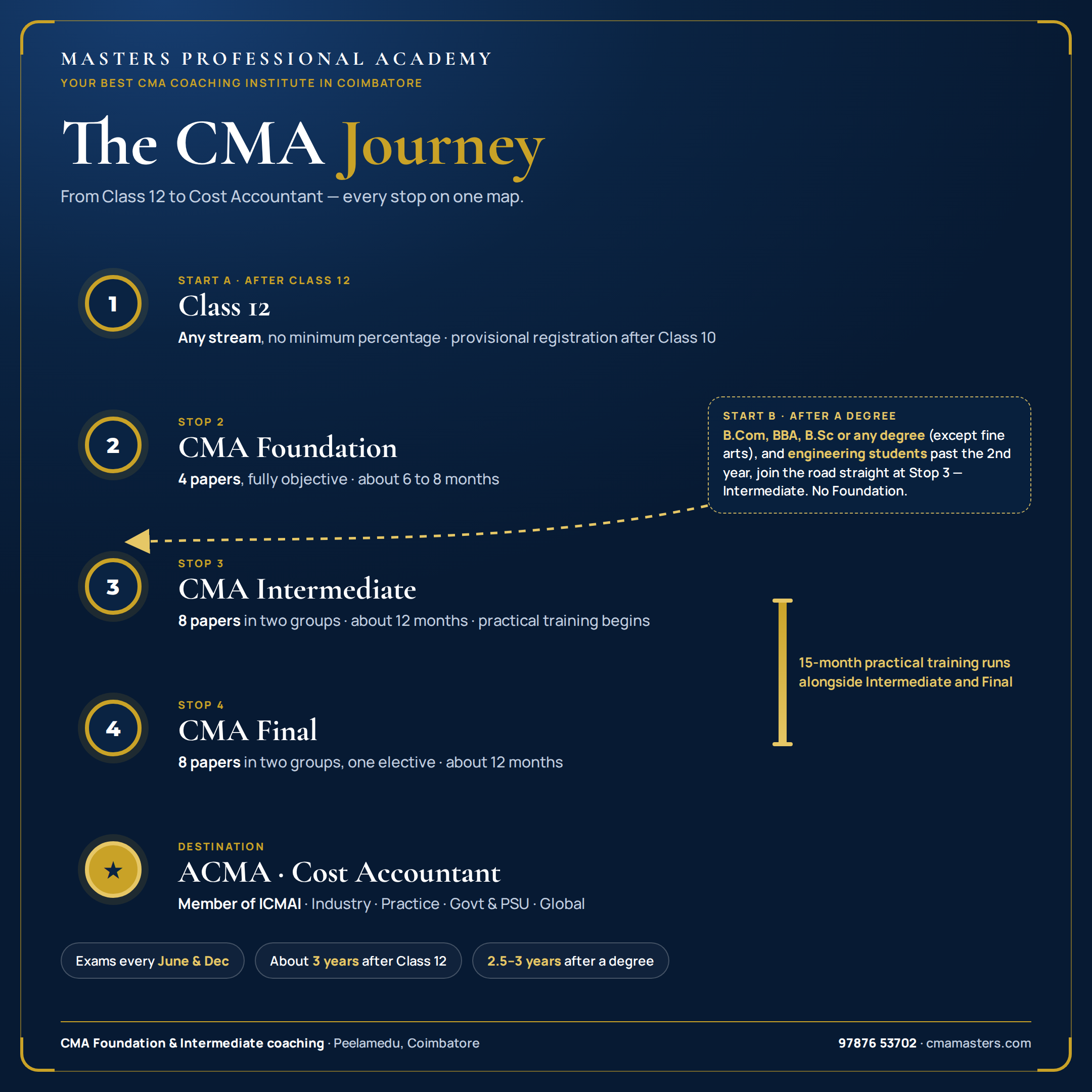
- Class 12Any stream · no minimum percentage · provisional registration possible after Class 10›
- CMA Foundation4 papers · fully objective · 6 to 8 months›
- CMA Intermediate8 papers in two groups · about 12 months · practical training begins›
- CMA Final8 papers in two groups · about 12 months · industry training›
- ACMA · Cost AccountantMembership of ICMAI · industry, practice, government or global
Graduates in any discipline (except fine arts) and engineering students who have completed the second year skip Foundation and start at stop three.
Want the actual downloads? Every official ICMAI link — study material for all 20 papers, previous year question papers term-wise, model papers with answers, the exam form, admit card and results — is on our CMA links page.
Entry routes
Which door do you enter through?
ICMAI keeps the entry simple. There is no minimum percentage, no stream requirement and no age limit at any level. Your qualification decides where you start; nothing else does.
Door 1
After Class 10Register for Foundation provisionally, write the exam after you pass Class 12. ICMAI gives 36 months to convert the provisional registration to regular.
Door 2
After Class 12, any streamCommerce, science or arts — a pass from any recognised board is enough. You start at CMA Foundation and write it in June or December.
Door 3
Graduates, or final-year studentsA degree in any discipline other than fine arts (music, dance, painting, sculpture, photography) takes you straight to CMA Intermediate. Final-year students register provisionally and have 18 months to submit the degree.
Door 4
Engineering, second year doneStudents who have completed the second year (Semester IV) of an engineering course, and qualified engineers, enter Intermediate directly.
Door 5
ICMAI’s CAT routePassing the Foundation (Entry Level) of ICMAI’s Certificate in Accounting Technicians course also opens Intermediate without the CMA Foundation exam.
Door 6
Already workingSame doors as above. If your job is in costing, accounts, audit, taxation or finance, you can apply to ICMAI for exemption from the practical training (Form T-3), so the road is shorter.
Registration closes on 31 January for the June term and 31 July for the December term at every level. Register early: the cut-off decides which exam you can write, and the study material reaches you only after registration. Read our full note on CMA course eligibility.
Stop by stop
What happens at each level
CMA Foundation
| Paper | Subject |
|---|---|
| Paper 1 | Fundamentals of Business Laws and Business Communication |
| Paper 2 | Fundamentals of Financial and Cost Accounting |
| Paper 3 | Fundamentals of Business Mathematics and Statistics |
| Paper 4 | Fundamentals of Business Economics and Management |
Passing: 40 marks in every paper and 50% in aggregate (200 out of 400). All four papers are written in the same term, in two shifts on the exam day.
Who writes it: everyone who enters after Class 12. Many of our Foundation students are in the first year of a degree and study in the evening batch; the December exam usually falls in the same weeks as college semester exams, so we plan the term with the student in advance.
What it does for you: the four papers are the base for everything that follows — the accounting and costing in Paper 2 return as Paper 6 and Paper 8 at Intermediate, and the law and economics come back at every level.
CMA Foundation coaching at MPACMA Intermediate
| Group I | |
|---|---|
| Paper 5 | Business Laws and Ethics |
| Paper 6 | Financial Accounting |
| Paper 7 | Direct and Indirect Taxation |
| Paper 8 | Cost Accounting |
| Group II | |
|---|---|
| Paper 9 | Operations Management and Strategic Management |
| Paper 10 | Corporate Accounting and Auditing |
| Paper 11 | Financial Management and Business Data Analytics |
| Paper 12 | Management Accounting |
Passing: 40 in every paper and 50% aggregate in the group. A paper in which you score 60 or more is exempted in later attempts even if the group is not cleared, as long as your registration is valid. Registration is valid for seven years.
The practical side starts here. Once you are registered for Intermediate you must complete 120 hours of skills training (Tally or another ERP 40 hours, MS-Office 40 hours, e-filing 20 hours, communication and soft skills 20 hours), and you may begin the 15-month practical training described at stop three — many students do it in their final year of college or straight after.
How students plan it: Group I in one term, Group II in the next is the common route; students with full-time hours write both groups together. Read doing CMA along with B.Com and CMA passing marks explained.
CMA Intermediate coaching at MPAPractical training — 15 months
ICMAI’s New Practical Training Scheme (2020) asks every student who registered for Intermediate on or after 11 February 2020 to complete 15 months of training before being admitted as a member. Training can be done under a practising Cost Accountant, in a company that meets ICMAI’s turnover norms, in a PSU or government body, or in a bank or financial institution. Register the training with ICMAI within 30 days of joining (Form T-1 for a practising Cost Accountant, Form T-4 for an organisation); months worked before the form is filed are lost.
Timing that matters: at least 10 months of training must be complete by 31 August to write the December Final exam, or by the end of February for the June exam, and Form T-5 is filed before the Final exam form. The simplest plan is to begin training the month you register for Intermediate, so it is finished before your Final result.
Stipend: ICMAI fixes a minimum monthly stipend — from 1 August 2024, ₹2,000 to ₹4,000 under a practising Cost Accountant and ₹15,000 to ₹25,000 for an Intermediate-stage trainee in a company, depending on the city category and year of training. The full table, the recognised employers and the forms are in the practical training section below.
Already working in costing, accounts, audit, tax or finance? Apply for exemption on Form T-3 (fee ₹2,000 as per the current notification) with your experience certificate, employer turnover proof and salary slip, by 31 May for the June term or 30 November for the December term. Full guide: CMA practical training.
CMA Final
| Group III | |
|---|---|
| Paper 13 | Corporate and Economic Laws |
| Paper 14 | Strategic Financial Management |
| Paper 15 | Direct Tax Laws and International Taxation |
| Paper 16 | Strategic Cost Management |
| Group IV | |
|---|---|
| Paper 17 | Cost and Management Audit |
| Paper 18 | Corporate Financial Reporting |
| Paper 19 | Indirect Tax Laws and Practice |
| Paper 20 | One elective: 20A Strategic Performance Management and Business Valuation · 20B Risk Management in Banking and Insurance · 20C Entrepreneurship and Startup |
Passing: the same 40-per-paper and 50%-aggregate rule per group, with the 60-mark paper exemption. Registration is valid for seven years.
Training at this level: 50 to 60 hours on SAP, Oracle or Dynamics, 20 to 30 hours of business and data analytics, and the 10-day Industry Oriented Training Programme (seven days of practical work on accounts finalisation, GST and income-tax filing, working capital, MIS and risk; three days of soft skills and interviews). The 15-month practical training must be complete before membership.
What the papers are about: Final is where costing becomes management — strategic cost management, corporate financial reporting, cost and management audit (the statutory work reserved for Cost Accountants), and a full paper each on direct and indirect tax at the practitioner level. The elective lets you lean towards valuation, banking and insurance risk, or entrepreneurship.
Membership: ACMA, then FCMA
Pass both Final groups, complete the training, and apply to ICMAI for Associate membership. You are now an ACMA and use the prefix CMA before your name. After five years of membership with the required experience you can become a Fellow (FCMA). A member who wants to practise independently takes a Certificate of Practice from ICMAI; a full-time certificate and a full-time salaried job cannot be held together.
Practical training · what students call articleship
The 15-month practical training, in detail
Students call it articleship; ICMAI calls it practical training. It is the part of the course that turns a student into a working professional, and the rules below are ICMAI’s New Practical Training Scheme 2020 as published on icmai.in.
Start early, finish before the Final result
- Applies to every student registered for Intermediate on or after 11 February 2020.
- You may begin the day your Intermediate registration is done — there is no need to wait for the exam.
- At least 10 months must be complete by 31 August to sit the December Final exam, or by the end of February for the June exam, and Form T-5 goes in before the Final exam form.
- All 15 months must be complete before the result of your last Final group is declared, and before you apply for membership.
- Working hours are 35 a week. The scheme has no part-time provision.
Employers ICMAI recognises
- Practising Cost Accountants and their firms.
- Companies with a turnover of ₹50 lakh or more (₹25 lakh for service companies).
- PSUs, government and semi-government bodies.
- Banks, insurance companies and financial institutions.
- Educational institutions and universities; cooperatives and NGOs.
- MSMEs and start-ups; management consultants case by case.
ICMAI publishes the registered training organisations and practising firms on icmai.in every year.
Areas of training
ICMAI’s approved areas are management accounting, cost accounting, financial accounting, taxation, auditing, compliance, corporate and commercial law, IT and ERP systems, project management, banking, insurance, insolvency, valuation, and teaching roles in finance and accounts. The training must be in one or more of these areas.
Forms and deadlines
| Form | What it does | When |
|---|---|---|
| T-1 | Registers training under a practising Cost Accountant | Within 30 days of joining |
| T-4 | Registers training in a company or organisation | Within 30 days of joining |
| T-5 | Confirms the training done, filed before the Final exam form | 10 months by 31 Aug (Dec exam) or end Feb (June exam) |
| T-3 | Exemption for students already working in costing, accounts, audit, tax or finance — fee ₹2,000, with experience certificate, employer turnover proof and salary slip | By 31 May (June exam) or 30 Nov (Dec exam) |
Months worked before the form is filed do not count, so file T-1 or T-4 in the first month. Everything is filed online on ICMAI’s training portal.
Minimum stipend fixed by ICMAI (from 1 August 2024)
| Where you train | Intermediate-stage trainee | Final-stage trainee | Qualified CMA |
|---|---|---|---|
| Practising Cost Accountant or firm | ₹2,000 a month in year 1, ₹3,000 in year 2, ₹4,000 in year 3 | ||
| Company or organisation · category X city | ₹20,000 – 25,000 | ₹25,000 – 30,000 | ₹42,000 – 50,000 |
| Company or organisation · category Y city | ₹18,000 – 22,000 | ₹22,000 – 27,000 | ₹40,000 – 45,000 |
| Company or organisation · category Z city | ₹15,000 – 20,000 | ₹20,000 – 25,000 | ₹37,000 – 42,000 |
Monthly minimums per ICMAI’s stipend revision effective 1 August 2024; each range runs from the first to the third year of training, and X, Y and Z are ICMAI’s city categories. These are floors — employers may pay more.
How MPA helps. We place our Intermediate students in training with Coimbatore organisations that meet ICMAI’s norms — practising Cost Accountants, companies above the turnover limit, banks and PSUs — and handle the selection, the T-4 and T-5 paperwork and a monthly review with the finance head; if a placement does not work, we arrange a replacement within 30 days. There is no placement fee: the organisation pays the stipend ICMAI prescribes. See CMA training partners.
Duration
How long the whole road takes
| After Class 12 | Term |
|---|---|
| Register for Foundation by 31 January | Year 1 |
| Foundation exam | June, Year 1 |
| Intermediate Group I | December, Year 1 |
| Intermediate Group II · practical training under way | June, Year 2 |
| Final Groups III and IV (together, or one per term) | June and December, Year 3 |
| Membership | Early Year 4 |
| After a degree | Term |
|---|---|
| Register for Intermediate by 31 January (or 31 July) | Year 1 |
| Intermediate Group I · training begins | June, Year 1 |
| Intermediate Group II | December, Year 1 |
| Final Group III | December, Year 2 |
| Final Group IV | June, Year 3 |
| Membership | Late Year 3 |
Realistic, not theoretical. Three years after Class 12 is the fastest road; most students take three and a half to four because one group needs a second attempt or a December term clashes with college exams. After a degree, two and a half to three years is the usual figure. Every missed term costs six months, which is why registration dates and the exam-form dates (about two months before each exam) matter more than any other planning detail. Our duration guide has the month-by-month plan, and the December 2026 exam dates are already out.
Cost
What ICMAI charges, level by level
| Level | Registration (includes ICMAI study material) | Exam fee per attempt |
|---|---|---|
| Foundation | ₹6,000, one payment | ₹1,200 |
| Intermediate | ₹23,100 for both groups, payable in instalments | ₹1,500 one group · ₹2,800 both |
| Final | ₹25,000, two instalments | ₹1,800 one group · ₹3,200 both |
| Whole course | About ₹54,000 in registration | About ₹7,000 if every group is cleared at the first attempt |
ICMAI revises fees from time to time; confirm the current figure on icmai.in before paying. Training programme fees and the membership fee are separate. Coaching is separate too and depends on the batch you choose — talk to us and we will explain it in one conversation. More on CMA course fees in India.
Where the road leads
Five paths after CMA
Path 1
Industry
The largest path. Costing executive, cost accountant, FP&A analyst, finance and accounts officer, internal audit associate, junior manager (finance) — in manufacturing, auto components, textiles, pumps and foundries, pharma, FMCG, oil and energy, metals, IT and consulting.
- Freshly qualified: about ₹4 to 8 lakh a year
- 3 to 5 years: ₹10 to 15 lakh
- Coimbatore freshers typically ₹3.5 to 5.5 lakh
Path 2
Practice
Take a Certificate of Practice and work for yourself. Cost audit under the Companies Act is reserved by law for practising Cost Accountants. Practices also do GST work and representation, internal and stock audit, certification, valuation, and insolvency work after the relevant registrations.
- Most strong practices start after 3 to 5 years in industry or under a practising CMA
- Starting a CMA practice
Path 3
Government and PSUs
ONGC, NTPC, BHEL, SAIL, Coal India and other PSUs list CMA among the qualifying degrees for finance executives, accounts officers and junior managers (finance), on PSU pay scales. Tamil Nadu undertakings and boards hire cost and accounts officers, and central and state bodies advertise finance posts that list CMA among the qualifying degrees — read each advertisement, because eligibility and age limits change from one notification to the next.
Path 4
Global
Under ICMAI’s agreement with ACCA (UK), a qualified Cost Accountant with five years’ experience is exempted from 9 of the 13 ACCA papers, and a CMA finalist or newer member from 7. ICMAI members also have arrangements with other bodies for advanced entry, and the qualification travels well — many members work in the Gulf and South-East Asia.
Path 5
Higher study and teaching
CMA plus an MBA is a common combination for finance leadership roles; ICMAI’s arrangement with IGNOU has let CMA students earn a B.Com or M.Com alongside the course (check the current intake with ICMAI). Members go on to PhD programmes and to teaching posts in commerce departments through UGC NET, and many practising CMAs teach part-time.
After the Final
Campus placement: how ICMAI places Cost Accountants
ICMAI’s Directorate of Training and Placement runs a campus placement programme after every Final result, in phases across the regions. Everything below is taken from ICMAI’s own placement pages and the figures it has released.
Eligibility and format
- Students who qualified in the latest term and the term before it — the April–May 2026 drive was open to the December 2025 and June 2025 batches — with a separate track for experienced CMAs from earlier batches.
- The 2026 drive ran in Chennai (27–30 April), Delhi (5–8 May), Mumbai (11–13 May), Ahmedabad (15–16 May), Kolkata (18 May) and Vijayawada (21 May). Coimbatore students go to the Chennai sessions for the southern region.
- Each company posts its job description — role, location and pay — on the ICMAI placement page and publishes its shortlist before the interview days.
Organisations on ICMAI’s 2026 schedule
Bharat Petroleum Corporation, Larsen & Toubro, ITC, Nestlé India, ICICI Bank, Reliance Jio, Tata Motors, Marico, Hindalco Industries, Kalpataru Projects International, RSM Astute Consulting and Sharp & Tannan Associates were among the 70-plus organisations listed for the April–May 2026 drive, for finance, costing, accounting and management-trainee roles. Between drives ICMAI also circulates openings for CMA candidates — recent ones from Genpact, BNY, MSTC and Volvo.
December 2023 drive
- 297 offers made.
- Average package ₹10 lakh a year; highest offer ₹19.7 lakh.
- 1,847 further opportunities notified through off-campus PSU recruitment in 2023–24.
ICMAI publishes each drive’s schedule and outcome on icmai.in; the figures change every term, so treat these as the most recent complete set rather than a promise.
The other routes to a job
- PSU notifications — ONGC, NTPC, BHEL, SAIL and Coal India list CMA among the qualifying degrees for finance and accounts posts.
- Direct hiring by companies and practising Cost Accountants, including the organisation where you did your 15-month training.
- Practice, with a Certificate of Practice from ICMAI after membership.
Placement is not automatic: marks, the skills-training modules and the interview decide it. Our notes on jobs after CMA and CMA salary in India go deeper.
Good to know
Three things students ask before they start
Syllabus 2026 is coming; December 2026 is still on Syllabus 2022. ICMAI has begun work on a revised syllabus, but no changeover term has been notified, and ICMAI always runs a transition window so students already in the course are not cut off. Waiting for it costs six months for nothing. Our note: should I wait for Syllabus 2026?
Registration and the exam form are two different things. Registration puts you in the course (by 31 January or 31 July); the exam form, about two months before each exam, books your seat. Miss the form and there is no admit card. Registration vs exam form.
Every official link in one place. Study material for all 20 papers, previous year question papers for six terms, model papers with answers, MCQ banks, the exam application form, admit card, results, the practical training portal and the campus placement pages — 500-plus ICMAI links, checked and sorted level by level on our CMA study material, question papers and exam links page.
You can work or study alongside. Registration is valid for seven years at Intermediate and Final, exams are twice a year, and one group per term is a normal pace. Working professionals and college students make up a large part of our classroom. Read CMA while working full time and registration validity.
Questions students and parents ask
Roadmap FAQ
Can I start CMA right after Class 12?
Yes. Any stream, any percentage. You register for CMA Foundation (by 31 January for the June exam or 31 July for December), write the four objective papers in one term, and move to Intermediate. Students who have passed Class 10 can register provisionally and write the exam after Class 12.
I have a B.Com, BBA or B.Sc. Do I have to write Foundation?
No. Graduates in any discipline other than fine arts enter CMA Intermediate directly, and final-year students can register provisionally with 18 months to submit the degree certificate. Engineering students can enter after completing the second year.
How many years does the full CMA course take?
About three years after Class 12 at the fastest, three and a half to four for most students; about two and a half to three years after a degree. Foundation takes six to eight months, Intermediate and Final about twelve months each, and the 15-month practical training runs alongside rather than after.
Is the 15-month practical training compulsory?
Yes, for every student registered for Intermediate on or after 11 February 2020. It can start the day you register for Intermediate, at least 10 months of it must be done before you write the Final exam, and all 15 months before you become a member. It is full-time — 35 hours a week — and students already working in costing, accounts, audit, tax or finance can apply for exemption on Form T-3.
What stipend does a CMA trainee get?
ICMAI fixes minimums, effective 1 August 2024: ₹2,000 to ₹4,000 a month under a practising Cost Accountant (rising each year), and in a company ₹15,000 to ₹25,000 a month for an Intermediate-stage trainee depending on the city category and year, ₹20,000 to ₹30,000 at the Final stage, and ₹37,000 to ₹50,000 for a qualified CMA. Employers may pay more.
What does the whole course cost at ICMAI?
About ₹54,000 in registration across the three levels (₹6,000 Foundation, ₹23,100 Intermediate, ₹25,000 Final) and about ₹7,000 in exam fees if every group is cleared at the first attempt. Training programmes and membership are charged separately. Coaching fees are separate from ICMAI’s fees.
Can I do CMA along with college or a full-time job?
Yes, and most of our students do. Foundation fits the first year of a degree, Intermediate the second and third years, with the December term planned around semester exams. Working professionals write one group per term in the evening batch, and registration stays valid for seven years.
What is the difference between CMA India and US CMA?
CMA India is the Cost and Management Accountant qualification of ICMAI, a statutory body set up by an Act of Parliament; its members alone can sign cost audits in India. US CMA is a two-part certification of the Institute of Management Accountants, USA. This page, and our coaching, are about the ICMAI course.
Does CMA have campus placement?
Yes. ICMAI runs its own campus placement programme after each Final result, in phases across Chennai, Delhi, Mumbai, Ahmedabad, Kolkata and Vijayawada, open to the latest two batches plus a track for experienced CMAs. The April–May 2026 drive listed 70-plus organisations, and ICMAI’s released figures for the December 2023 drive were 297 offers, an average of ₹10 lakh and a highest offer of ₹19.7 lakh a year. Placement depends on your marks and your interview, so the training and the skills programmes matter as much as the papers.
Tell us where you are; we will map your road
Class 12, second year of college, final year, or already working — send us that one line and we will tell you which door you enter through, which exam term you can realistically aim for, and which batch fits your day. Free guidance, no obligation to join.
WhatsApp usCall 97876 53702